Primer for Plein Air: Part 1 / Gear
What do you need for an easel or a paint box?
While you're waiting for that last snowbank to melt, you should be taking stock of what you have for gear and materials. When the moment strikes and you're finally able to go out without first having to recharge the batteries in your heated socks, it'll be easier if you have everything ready to roll.
At the start of plein air painting season, I always lay out my kit on the studio bench to see if I have all the right components. (And I also take the opportunity to re-evaluate what I used last year; I like to change things up once in awhile, like adding a new color or a different brush.) Then, once I'm satisfied the kit is complete, I pack it up—I like to keep it as a sort of "go bag" that I can just grab as I head out the door.
The best advice I can give: Keep it simple. You just need something to paint with and something to paint on. In fact, you don't even need an easel! Many times, I've gone out with just a small kit and worked in my lap. But most people use an easel, so let's start with that.
Easels & Paint Boxes
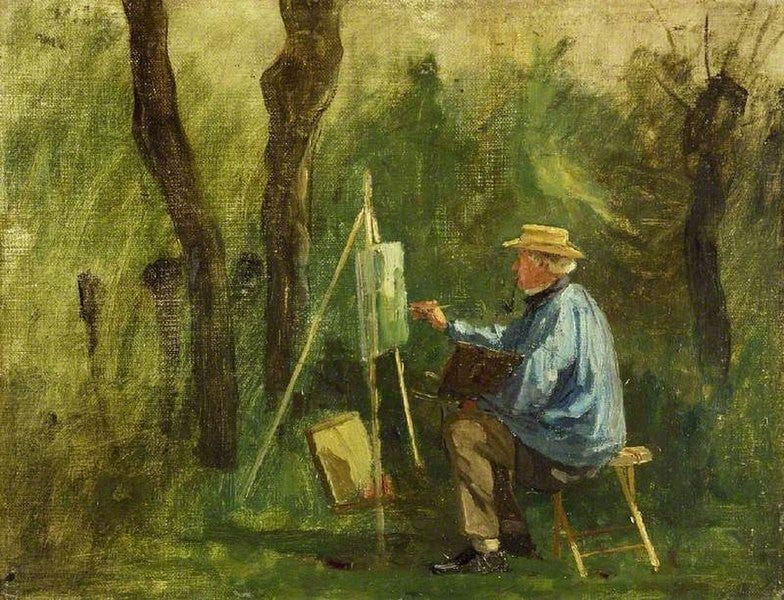
Outdoor painters back in the 19th century mostly used a primitive easel that consisted of three sticks hinged together with some kind of horizontal bar to prop a panel on. (See the illustration at top.) Paint boxes were common, too. These had room for brushes and paints and used a cleverly-designed, slotted lid to hold a panel while you painted on it. These ideas were later incorporated into the Jullian French easel, which is a completely self-contained painting studio.
All of these are still available today, but paint boxes and easels have evolved to a point where the artist has a confusing range of choices. If you're like me, over time you'll accumulate a whole closet full of them. I find it hard to discard any, since each has its pluses and minuses. But when I'm looking for an easel, here are a few things I consider:
Lightness. Heavy tires you out. Carry everything easily in one trip from the car.
Simplicity. Complicated steals time and energy. The fewer the hinges, screws and bolts, the better.
Stability. Rickety makes for disasters. Make sure the easel has a broad footprint so it'll stand up to wind. If you get a tripod, make sure the head isn't plastic; you can't tighten plastic enough to avoid wobble.
Basic types of easels and boxes:
Pochade box. This has room for everything, including wet panel storage, brushes and paints. An example is the Guerrilla Painter 8x10 Cigar Box, which is small enough to use in your lap. (But it does have a mount for a tripod.)
Clamshell. With this stripped-down box, the bottom serves as a palette and the top, a panel holder. This requires a modular approach to your gear; you'll need to carry separately a wet canvas carrier, turps jar, paint box and brush holder. (Plus a tripod.) An example is the EasyL ezTravel.
A palette/panel holder combo. The palette rests on the legs of a tripod, with a panel holder attached to the tripod's mast. Like the clamshell concept, it's modular. One example of this is the En Plein Air Pro Traveler.
Gloucester-style easel. This is more of a traditional three-stick easel that requires you also have to have some sort of paint box and palette. Designed for the rugged and stormy maritime environment, it has a large footprint, making it incredibly stable in the wind. (I had a student once who brought one to class, and he painted without any problems in Arizona’s gale-force spring winds.) Check out the Take-It Easel.
French easel. It has plenty of room for everything, serves as its own tripod and is also very stable in the wind. The only drawback is that it can be heavy and takes a little practice in setting up. (See my video below on how to set it up.) Although a French easel is now considered old-school, it is my go-to when all else fails. The original Jullian French easel, in my opinion, is the best; so many knockoffs use cheap wood and fittings. By the way, here's a secret—you can also use it as a wet canvas carrier when collapsed.
Most likely, you'll find no perfect solution. Visit your painting buddies or take a workshop to see what others use—you'll see more options and might find something that suits your needs better.
What do I use these days? Lately, I've gone to painting a small format, and I use the Guerrilla Painter 8x10 Cigar Box for oil. I may or may not use a tripod, depending on my day. For pastel, I use the Heilman Designs Double-Sketchbox and optional mast with a tripod. For gouache, I just work in my lap on a board or again, depending on my day, may fit the board to a tripod mount. My tripod is the ProMaster XC-525. The French easel is my fall-back, should a tripod break.
Next time: Tools and Stuff
By the way, don't forget that I offer several Plein Air Essential courses that will give you more guidance on getting started! They are online, self-study and self-paced. You can check them out on this page.
Curious about how to set up a French easel? It doesn’t require you to be a gymnast or contortionist. Here’s a video I made years ago on how to set it up:

